
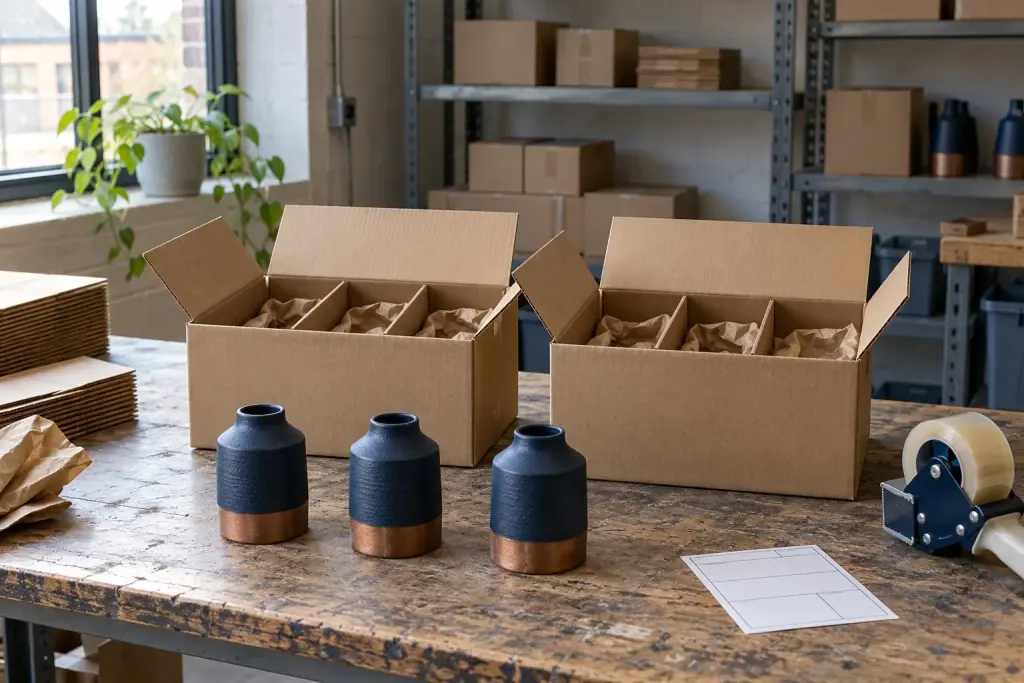
The product sample has passed its appearance checks, but it has never travelled inside the proposed packaging. Before committing to a first full order, ask what a packed sample would look like from the receiver’s side. A short rehearsal can expose questions that a photograph of the product alone cannot answer.
This is a practical coordination exercise, not a certified transport test. Fragile, hazardous, food-contact or otherwise regulated goods may need specialist packaging requirements and testing. Define those requirements with qualified people rather than treating a desk check as proof of protection.
Rehearse the unpacking, not just the closing
For a fictional order of decorative ceramic objects, ask the supplier to prepare one representative packed unit with the proposed dividers, wrapping and outer carton. Request photographs in sequence: empty carton, fitted dividers, loaded product and closed carton. Identify the sample version so a later material substitution is visible.
At receipt, follow the opening route a colleague would actually use. Can the contents be lifted without pulling against a fragile edge? Does loose material obscure a small accessory? Is it clear which packaging can be removed first? Write observations as specific actions rather than “packing poor.”
- Identify the packed sample and record its condition before opening.
- Open it using the proposed instructions and photograph any confusing step.
- Check that all intended components are accessible and identifiable.
- List changes, the owner of each change, and whether another trial is required.
Agree what happens when materials change
A divider with the same outline may use a different material. A larger carton may create more movement. Ask the supplier which changes require review and how the current packaging specification will be identified on the order. Avoid approving only a photograph while leaving the underlying materials unspecified.
Include the receiving team in that conversation. They may need to unpack several units at once, retain a protective insert for later handling, or store items in a particular orientation. Those are questions to establish, not assumptions the supplier can reliably infer.
Close the trial with a decision
Keep a compact record: sample reference, observations, agreed revisions and unresolved testing. If you approve the opening sequence but still need transport validation, say so. A successful unpacking rehearsal does not establish that every shipment will arrive undamaged.
The result should be an agreed next version, not a folder of attractive packing photographs. Refer back to it when the first full delivery arrives; that makes the rehearsal useful to the people who will actually receive the goods.