
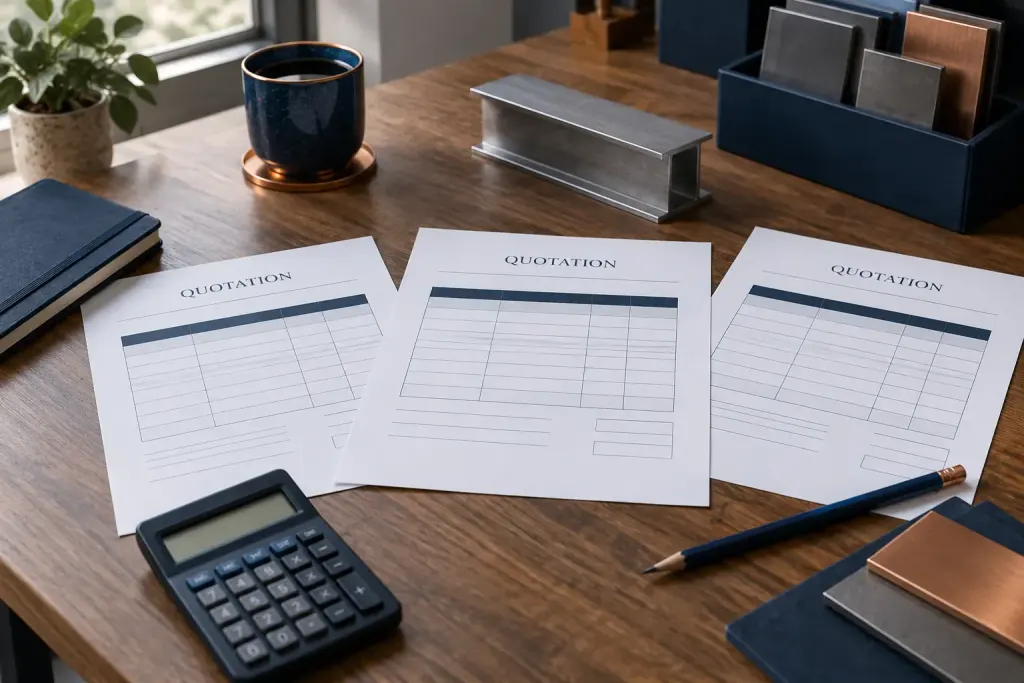
A low quotation can be perfectly reasonable and still answer a different question from the other two offers on your desk. One supplier may price finished goods from a production-ready file. Another may include preparing that file. A third may include only the first design revision. Comparing the totals first hides those differences.
Start by writing the job in a sentence that contains an output and a handover point. For example: “Produce the agreed display stand from our final drawing, pack each unit separately, and provide the approved assembly sheet.” This fictional brief gives you something to compare without pretending every buying project follows the same process.
A scope worksheet you can send back
| Work item | Question for each supplier |
|---|---|
| Input files | Which files must we supply, and in what condition? |
| Revisions | What changes are included before production approval? |
| Tools and setup | Is a separate setup required, and what deliverable does it create? |
| Inspection | Which checks are included and what record will we receive? |
| Handover | Exactly what will be supplied with the finished item? |
Use “included,” “excluded” and “awaiting clarification” as separate entries. A blank cell should remain a question, not become an assumed promise. Keep the supplier’s answer alongside your summary so someone else can trace the decision.
Try the comparison on one disputed item
Suppose Quote A includes an assembly sheet and Quote B does not mention one. Ask B whether it can supply the same sheet, what information it needs and whether doing so changes the offer. Do not add a guessed allowance simply to complete your spreadsheet. Until the response arrives, the comparison is incomplete.
Also check who approves the sheet. A document may be included in the price without the supplier taking responsibility for every fact in it. Naming the review step prevents an included deliverable from becoming an unattended task.
Preserve alternatives that matter
Not every quotation needs to become identical. A supplier may propose a simpler construction that meets your actual need. Record it as an alternative with its own acceptance criteria, instead of mixing its lower cost into the original specification. You can then decide whether the change is useful on its merits.
At the decision meeting, present the scope gaps before the ranking. The most useful conclusion may be “two comparable offers and one alternative,” not a forced league table of three totals. This worksheet is an editorial purchasing aid, not a contract interpretation; seek the appropriate expertise when a technical or legal obligation is unclear.